|
|
|
Log In | Sign Up | ||
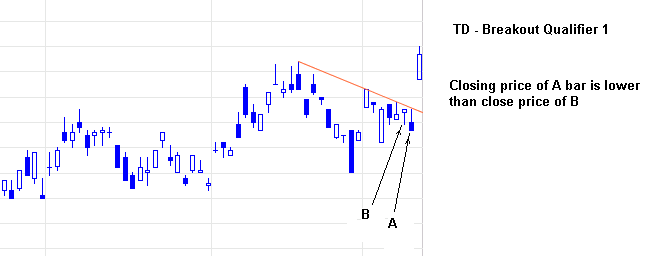
Thomas DeMark's Approach, Part II: TD Breakout QualifiersA break of a trend line is only useful if it is real. Many breakouts fail within a bar or two and trap traders who acted on them. Thomas DeMark defined three tests, called TD breakout qualifiers, to judge whether a break of a TD-line (see Part I) is likely to hold. A breakout that passes at least one of them is treated as valid. Qualifier 1: the close before the breakoutThe first qualifier looks at the bar just before the breakout:
The logic: if price breaks out right after a move in the opposite direction, the buyers (or sellers) behind the break are strong enough to reverse the short-term move, not just extend it.
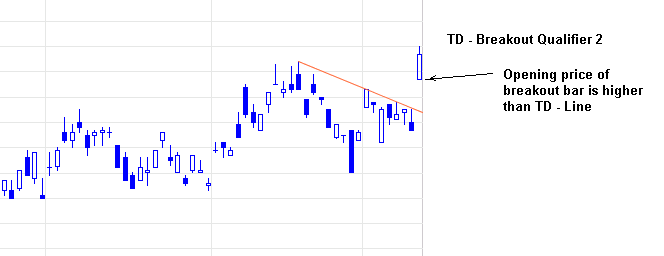
Fig. 1. The first TD breakout qualifier. Qualifier 2: the open of the breakout barThe second qualifier is stronger than the first. DeMark considered it enough to enter even when the first qualifier says the breakout is false.
A gap through the line at the open shows that demand (or supply) built up before the session started.
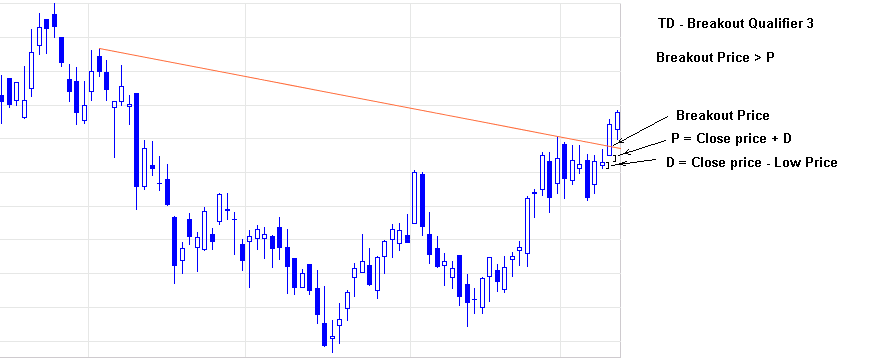
Fig. 2. The second TD breakout qualifier. Qualifier 3: buying or selling pressureThe third qualifier estimates whether the pressure on the previous bar was enough to carry price through the line:
Fig. 3. The third TD breakout qualifier. What comes nextOnce a breakout passes a qualifier, the next question is how far price is likely to go. DeMark answered it with three TD price projections, covered in Part III. Part 2 of 5 in the Thomas DeMark’s Approach series. Previous: Part I: TD-Points and TD-Lines. Next: Part III: Price Projections. Screen for it on MarketInOutEach TD-Line event in our formula language comes in four forms: the plain cross and one for each qualifier ( exch(nyse,nasdaq) and type(stock) and td_ubm1q2 Rewritten in October 2026 from an article in MarketInOut’s original article library. |
Disclaimer - Privacy Policy - Terms of Service - Cookies - FAQ - Affiliates - Blog |