Stock Screener - US Stocks, Forex and ETFs
Please enable JavaScript to view this page content properly  
 Home
Sign In 
 Investing
Value Investing
Growth Investing
Income Investing
Dogs of the Dow
Growth Leaders
 Day Trading
Price Trends
Trend Lines
Trend Indicators
Price Action
Fibonacci Levels
Moving Averages
Oscillators
Channels
Chart Patterns
DeMark's Approaches
Volume Indicators
Volume Action
 Fundamental Screens
Price / Volume
52 Week High / Low
Earnings Per Share
Price / Earnings Ratio
Return On Equity (%)
Operating Metrics
Financial Ratios
Dividend
 Custom Screens
Advanced Stock Screener
My Stock Screens
 Tools
Basic Chart
Technical Analyzer
Trade Alert
Ticker List
 Help
Education
Articles
Contact Us
 Partners
Affiliate Program
Partners
Link to Us
 Site Search
     
 Kagi - Technical Analysis from A to Z
KAGI

Overview

Kagi charts are believed to have been created around the time that the Japanese stock market began trading in the 1870s. Kagi charts display a series of connecting vertical lines where the thickness and direction of the lines are dependent on the price action. The charts ignore the passage of time.

If prices continue to move in the same direction, the vertical line is extended. However, if prices reverse by a "reversal" amount, a new kagi line is then drawn in a new column. When prices penetrate a previous high or low, the thickness of the kagi line changes.

Kagi charts were brought to the United States by Steven Nison when he published the book, Beyond Candlesticks.


Interpretation

Kagi charts illustrate the forces of supply and demand on a security:

  • A series of thick lines shows that demand is exceeding supply (a rally).

  • A series of thin lines shows that supply is exceeding demand (a decline).

  • Alternating thick and thin lines shows that the market is in a state of equilibrium (i.e., supply equals demand).

The most basic trading technique for kagi charts is to buy when the kagi line changes from thin to thick and to sell when the kagi line changes from thick to thin.

A sequence of higher-highs and higher-lows on a kagi chart shows the underlying forces are bullish. Whereas, lower-highs and lower-lows indicate underlying weakness.


Example

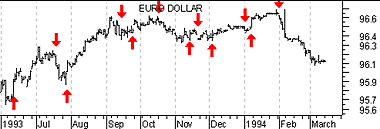
The following chart shows a 0.02-point kagi chart and a classic bar chart of Euro Dollars.
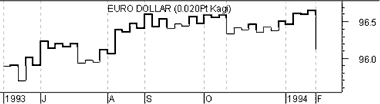

I drew "buy" arrows on the bar chart when the kagi lines changed from thin to thick and drew "sell" arrows when the lines changed from thick to thin.


Calculation

The first closing price in a kagi chart is the "starting price." To draw the first kagi line, today's close is compared to the starting price.

  • If today's price is greater than or equal to the starting price, then a thick line is drawn from the starting price to the new closing price.

  • If today's price is less than or equal to the starting price, then a thin line is drawn from the starting price to the new closing price.

To draw subsequent lines, compare the closing price to the tip (i.e. bottom or top) of the previous kagi line:

  • If the price continued in the same direction as the previous line, the line is extended in the same direction, no matter how small the move.

  • If the price moved in the opposite direction by at least the reversal amount (this may take several days), then a short horizontal line is drawn to the next column and a new vertical line is drawn to the closing price.

  • If the price moved in the opposite direction of the current column by less than the reversal amount no lines are drawn.

If a thin kagi line exceeds the prior high point on the chart, the line becomes thick. Likewise, if a thick kagi line falls below the prior low point, the line becomes thin.


Kagi Chart Patterns Screener US STOCKS ETF FOREX
  Thick Line 2459 387 10
  Thick Line Emergence 560 80 4
  Thin Line 1917 269 25
  Thin Line Emergence 161 14 2
 

 Preface
Preface
Introduction
Acknowledgments
Terminology
To Learn More

 Content
Technical Analysis
Price Fields
Charts
Support & Resistance
Trends
Moving Averages
Indicators
Market Indicators
Line Studies
Periodicity
The Time Element
Conclusion

 Reference
 Reference
 Absolute Breadth Index
 Accumulation/Distribution
 Accumulation Swing Index
 Advance/Decline Line
 Advance/Decline Ratio
 Advancing-Declining Issues
 Advancing, Declining,
   Unchanged Volume

 Andrews' Pitchfork
 Arms Index
 Average True Range
 Bollinger Bands
 Breadth Thrust
 Bull/Bear Ratio
 Candlesticks, Japanese
 CANSLIM
 Chaikin Oscillator
 Commodity Channel Index
 Commodity Selection Index
 Correlation Analysis
 Cumulative Volume Index
 Cycles
 Demand Index
 Detrended Price Oscillator
 Directional Movement
 Dow Theory
 Ease of Movement
 Efficient Market Theory
 Elliott Wave Theory
 Envelopes (Trading Bands)
 Equivolume
 Fibonacci Studies
 Four Percent Model
 Fourier Transform
 Fundamental Analysis
 Gann Angles
 Herrick Payoff Index
 Interest Rates
 Kagi
 Large Block Ratio
 Linear Regression Lines
 MACD
 Mass Index
 McClellan Oscillator
 McClellan Summation Index
 Median Price
 Member Short Ratio
 Momentum
 Money Flow Index
 Moving Averages
 Negative Volume Index
 New Highs-Lows Cumulative
 New Highs-New Lows
 New Highs/Lows Ratio
 Odd Lot Balance Index
 Odd Lot Purchases/Sales
 Odd Lot Short Ratio
 On Balance Volume
 Open Interest
 Open-10 TRIN
 Option Analysis
 Overbought/Oversold
 Parabolic SAR
 Patterns
 Percent of Resistance
 Percent Retracement
 Performance
 Point & Figure
 Positive Volume Index
 Price and Volume Trend
 Price Oscillator
 Price Rate-of-Change
 Public Short Ratio
 Puts/Calls Ratio
 Quadrant Lines
 Relative Strength, Comparative
 Relative Strength Index
 Renko
 Speed Resistance Lines
 Spreads
 Standard Deviation
 STIX
 Stochastic Oscillator
 Swing Index
 Three Line Break
 Time Series Forecast
 Tirone Levels
 Total Short Ratio
 Trade Volume Index
 Trendlines
 TRIX
 Turn Price
 Typical Price
 Ultimate Oscillator
 Upside/Downside Ratio
 Upside-Downside Volume
 Vertical Horizontal Filter
 Volatility, Chaikin's
 Volume
 Volume Oscillator
 Volume Rate-of-Change
 Weighted Close
 Williams' Accumulation/Distribution
 Williams' %R
 Zig Zag

 Author
Bibliography
About the Author


Copyright © 2007-2010 Market In&Out. All rights reserved.
Stock Screener - Trend Lines - Fibonacci Stock Screener - Candlesticks - Advanced Stock Screener
Market In/Out Home Page - Disclaimer - Technical Analysis Education - Contact Us