|
BOLLINGER BANDS
Overview
Bollinger Bands are similar to moving average envelopes. The
difference between Bollinger Bands and envelopes is envelopes are plotted at a fixed
percentage above and below a moving average, whereas Bollinger Bands are plotted at
standard deviation levels above and below a moving average. Since standard deviation is a
measure of volatility, the bands are self-adjusting: widening during volatile markets and
contracting during calmer periods.
Bollinger Bands were created by John Bollinger.
Interpretation
Bollinger Bands are usually displayed on top of security prices, but they can be displayed
on an indicator. These comments refer to bands displayed on prices.
As with moving average envelopes, the basic interpretation of Bollinger Bands is that
prices tend to stay within the upper- and lower-band. The distinctive characteristic of
Bollinger Bands is that the spacing between the bands varies based on the volatility of the
prices. During periods of extreme price changes (i.e., high volatility), the bands widen
to become more forgiving. During periods of stagnant pricing (i.e., low volatility), the
bands narrow to contain prices.
Mr. Bollinger notes the following characteristics
of Bollinger Bands.
- Sharp price changes tend to occur after the bands tighten, as volatility lessens.
- When prices move outside the bands, a continuation of the current trend is implied.
- Bottoms and tops made outside the bands followed by bottoms and tops made inside the
bands call for reversals in the trend.
- A move that originates at one band tends to go all the way to the other band. This
observation is useful when projecting price targets.
Example
The following chart shows Bollinger Bands on Exxon's prices.
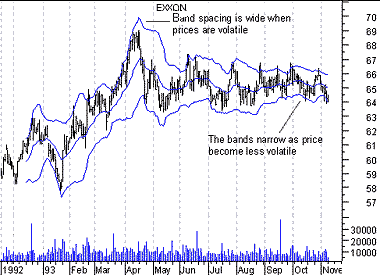
The Bands were calculated
using a 20-day exponential moving average and are spaced two deviations apart.
The bands were at their widest when prices were volatile during April. They narrowed
when prices entered a consolidation period later in the year. The narrowing of the bands
increases the probability of a sharp breakout in prices. The longer prices remain within
the narrow bands the more likely a price breakout.
Calculation
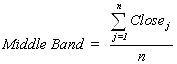
Bollinger Bands are displayed as three bands. The middle band is a normal
moving average. In the following formula, "n" is the number of time periods in the moving
average (e.g., 20 days).
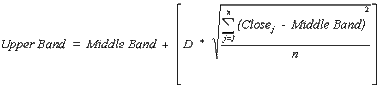
The upper band is the same as the middle band, but it is shifted up by the number of
standard deviations (e.g., two deviations). In this next formula, "D" is the number of
standard deviations.
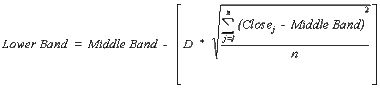
The lower band is the moving average shifted down by the same number of standard
deviations (i.e., "D").
Mr. Bollinger recommends using "20" for the number of periods in the moving average,
calculating the moving average using the "simple" method (as shown in the formula for the
middle band), and using 2 standard deviations. He has also found that moving averages of
less then 10 periods do not work very well.
|
|
Action |
| Bollinger Bands(20,2) Squeeze |



|
| Bollinger Bands(20,2) Strong Squeeze |
|
| Bollinger Bands(20,2) Squeeze 50% or Less |
|
| Bollinger Bands(20,2) Squeeze 40% or Less |
|
| Bollinger Bands(20,2) Squeeze 30% or Less |
|
| Bollinger Bands(20,2) Squeeze 20% or Less |
|
| Bollinger Bands(20,2) Squeeze 10% or Less |
|
| Price Crossed Above Upper Band of Bollinger Bands(20,2) |
|
| Price Crossed Above Middle Line of Bollinger Bands(20,2) |
|
| Price Crossed Above Lower Band of Bollinger Bands(20,2) |
|
| Price Crossed Below Upper Band of Bollinger Bands(20,2) |
|
| Price Crossed Below Middle Line of Bollinger Bands(20,2) |
|
| Price Crossed Below Lower Band of Bollinger Bands(20,2) |
|
| Price Touched Above Upper Band of Bollinger Bands(20,2) |
|
| Price Touched Above Middle Line of Bollinger Bands(20,2) |
|
| Price Touched Above Lower Band of Bollinger Bands(20,2) |
|
| Price Touched Below Upper Band of Bollinger Bands(20,2) |
|
| Price Touched Below Middle Line of Bollinger Bands(20,2) |
|
| Price Touched Below Lower Band of Bollinger Bands(20,2) |
|
| Price Bounced Up From Upper Band of Bollinger Bands(20,2) |
|
| Price Bounced Up From Middle Band of Bollinger Bands(20,2) |
|
| Price Bounced Up From Lower Band of Bollinger Bands(20,2) |
|
| Price Bounced Down From Upper Band of Bollinger Bands(20,2) |
|
| Price Bounced Down From Middle Band of Bollinger Bands(20,2) |
|
| Price Bounced Down From Lower Band of Bollinger Bands(20,2) |
|
| Price Is Above Upper Band of Bollinger Bands(20,2) |
|
| Price Is Above Lower Band of Bollinger Bands(20,2) |
|
| Price Is Below Upper Band of Bollinger Bands(20,2) |
|
| Price Is Below Lower Band of Bollinger Bands(20,2) |
|
|
|