Stock Screener - US Stocks, Forex and ETFs
Please enable JavaScript to view this page content properly  
 Home
Sign In 
 Investing
Value Investing
Growth Investing
Income Investing
Dogs of the Dow
Growth Leaders
 Day Trading
Price Trends
Trend Lines
Trend Indicators
Price Action
Fibonacci Levels
Moving Averages
Oscillators
Channels
Chart Patterns
DeMark's Approaches
Volume Indicators
Volume Action
 Fundamental Screens
Price / Volume
52 Week High / Low
Earnings Per Share
Price / Earnings Ratio
Return On Equity (%)
Operating Metrics
Financial Ratios
Dividend
 Custom Screens
Advanced Stock Screener
My Stock Screens
 Tools
Basic Chart
Technical Analyzer
Trade Alert
Ticker List
 Help
Education
Articles
Contact Us
 Partners
Affiliate Program
Partners
Link to Us
 Site Search
     
 Gann Angles - Technical Analysis from A to Z
GANN ANGLES

Overview

W. D. Gann (1878-1955) designed several unique techniques for studying price charts. Central to Gann's techniques was geometric angles in conjunction with time and price. Gann believed that specific geometric patterns and angles had unique characteristics that could be used to predict price action.

All of Gann's techniques require that equal time and price intervals be used on the charts, so that a rise/run of 1 x 1 will always equal a 45 degree angle.


Interpretation

Gann believed that the ideal balance between time and price exists when prices rise or fall at a 45 degree angle relative to the time axis. This is also called a 1 x 1 angle (i.e., prices rise one price unit for each time unit).

Gann Angles are drawn between a significant bottom and top (or vice versa) at various angles. Deemed the most important by Gann, the 1 x 1 trendline signifies a bull market if prices are above the trendline or a bear market if below. Gann felt that a 1 x 1 trendline provides major support during an up-trend and when the trendline is broken, it signifies a major reversal in the trend. Gann identified nine significant angles, with the 1 x 1 being the most important:

1 x 8 - 82.5 degrees
1 x 4 - 75 degrees
1 x 3 - 71.25 degrees
1 x 2 - 63.75 degrees
1 x 1 - 45 degrees
2 x 1 - 26.25 degrees
3 x 1 - 18.75 degrees
4 x 1 - 15 degrees
8 x 1 - 7.5 degrees

Note that in order for the rise/run values (e.g., 1 x 1, 1 x 8, etc) to match the actual angles (in degrees), the x- and y-axes must have equally spaced intervals. This means that one unit on the x-axis (i.e., hour, day, week, month, etc) must be the same distance as one unit on the y-axis. The easiest way to calibrate the chart is make sure that a 1 x 1 angle produces a 45 degree angle.

Gann observed that each of the angles can provide support and resistance depending on the trend. For example, during an up-trend the 1 x 1 angle tends to provide major support. A major reversal is signaled when prices fall below the 1 x 1 angled trendline. According to Gann, prices should then be expected to fall to the next trendline (i.e., the 2 x 1 angle). In other words, as one angle is penetrated, expect prices to move and consolidate at the next angle.

Gann developed several techniques for studying market action. These include Gann Angles, Gann Fans, Gann Grids and Cardinal Squares.


Examples

A Gann Fan displays lines at each of the angles that Gann identified. The following chart shows a Gann Fan on the S&P 500.
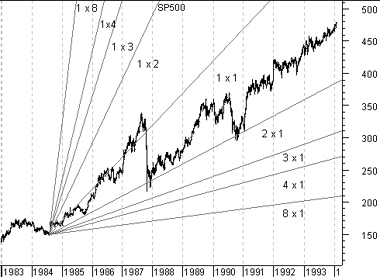
You can see that the S&P bounced off the 1 x 1 and 2 x 1 lines.

This next chart shows the same S&P 500 data with a Gann Grid.
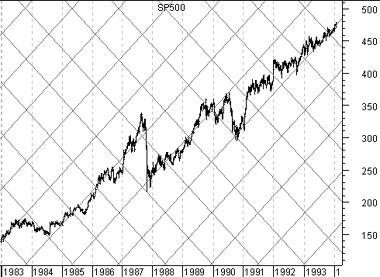
This is an 80 x 80 grid (each line on the grid is 1 x 1 and the lines are spaced 80 weeks apart).


 Preface
Preface
Introduction
Acknowledgments
Terminology
To Learn More

 Content
Technical Analysis
Price Fields
Charts
Support & Resistance
Trends
Moving Averages
Indicators
Market Indicators
Line Studies
Periodicity
The Time Element
Conclusion

 Reference
 Reference
 Absolute Breadth Index
 Accumulation/Distribution
 Accumulation Swing Index
 Advance/Decline Line
 Advance/Decline Ratio
 Advancing-Declining Issues
 Advancing, Declining,
   Unchanged Volume

 Andrews' Pitchfork
 Arms Index
 Average True Range
 Bollinger Bands
 Breadth Thrust
 Bull/Bear Ratio
 Candlesticks, Japanese
 CANSLIM
 Chaikin Oscillator
 Commodity Channel Index
 Commodity Selection Index
 Correlation Analysis
 Cumulative Volume Index
 Cycles
 Demand Index
 Detrended Price Oscillator
 Directional Movement
 Dow Theory
 Ease of Movement
 Efficient Market Theory
 Elliott Wave Theory
 Envelopes (Trading Bands)
 Equivolume
 Fibonacci Studies
 Four Percent Model
 Fourier Transform
 Fundamental Analysis
 Gann Angles
 Herrick Payoff Index
 Interest Rates
 Kagi
 Large Block Ratio
 Linear Regression Lines
 MACD
 Mass Index
 McClellan Oscillator
 McClellan Summation Index
 Median Price
 Member Short Ratio
 Momentum
 Money Flow Index
 Moving Averages
 Negative Volume Index
 New Highs-Lows Cumulative
 New Highs-New Lows
 New Highs/Lows Ratio
 Odd Lot Balance Index
 Odd Lot Purchases/Sales
 Odd Lot Short Ratio
 On Balance Volume
 Open Interest
 Open-10 TRIN
 Option Analysis
 Overbought/Oversold
 Parabolic SAR
 Patterns
 Percent of Resistance
 Percent Retracement
 Performance
 Point & Figure
 Positive Volume Index
 Price and Volume Trend
 Price Oscillator
 Price Rate-of-Change
 Public Short Ratio
 Puts/Calls Ratio
 Quadrant Lines
 Relative Strength, Comparative
 Relative Strength Index
 Renko
 Speed Resistance Lines
 Spreads
 Standard Deviation
 STIX
 Stochastic Oscillator
 Swing Index
 Three Line Break
 Time Series Forecast
 Tirone Levels
 Total Short Ratio
 Trade Volume Index
 Trendlines
 TRIX
 Turn Price
 Typical Price
 Ultimate Oscillator
 Upside/Downside Ratio
 Upside-Downside Volume
 Vertical Horizontal Filter
 Volatility, Chaikin's
 Volume
 Volume Oscillator
 Volume Rate-of-Change
 Weighted Close
 Williams' Accumulation/Distribution
 Williams' %R
 Zig Zag

 Author
Bibliography
About the Author


Copyright © 2007-2010 Market In&Out. All rights reserved.
Stock Screener - Trend Lines - Fibonacci Stock Screener - Candlesticks - Advanced Stock Screener
Market In/Out Home Page - Disclaimer - Technical Analysis Education - Contact Us