|
CANDLESTICKS, JAPANESE
Overview
In the 1600s, the Japanese developed a method of technical analysis to analyze the price of
rice contracts. This technique is called candlestick charting. Steven Nison is credited
with popularizing candlestick charting and has become recognized as the leading expert on
their interpretation.
Candlestick charts display the open, high, low, and closing prices in a format similar
to a modern-day bar-chart, but in a manner that extenuates the relationship between the
opening and closing prices. Candlestick charts are simply a new way of looking at prices,
they don't involve any calculations.
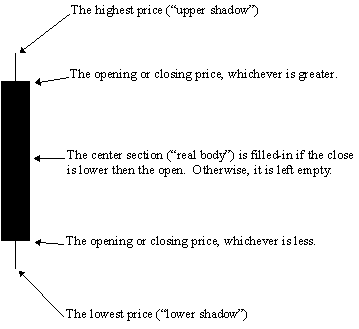
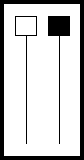
Each candlestick represents one period (e.g., day) of data. Figure 45 displays the
elements of a candle.
Figure 45
Interpretation
I have met investors who are attracted to candlestick charts by their mystique--maybe they
are the "long forgotten Asian secret" to investment analysis. Other investors are
turned-off by this mystique--they are only charts, right? Regardless of your feelings
about the heritage of candlestick charting, I strongly encourage you to explore their use.
Candlestick charts dramatically illustrate changes in the underlying supply/demand
lines.
Because candlesticks display the relationship between the open, high, low, and closing
prices, they cannot be displayed on securities that only have closing prices, nor were they
intended to be displayed on securities that lack opening prices. If you want to display a
candlestick chart on a security that does not have opening prices, I suggest that you use
the previous day's closing prices in place of opening prices. This technique can create
candlestick lines and patterns that are unusual, but valid.
The interpretation of candlestick charts is based primarily on patterns. The most
popular patterns are explained below.
| Bullish Patterns |
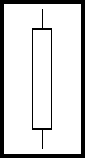 |
Long white (empty) line. This is a bullish line. It occurs when
prices open near the low and close significantly higher near the period's high. |
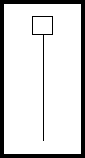 |
Hammer. This is a bullish line if it occurs after a significant
downtrend. If the line occurs after a significant up-trend, it is called a
Hanging Man. A Hammer is identified by a small real body (i.e., a small range
between the open and closing prices) and a long lower shadow (i.e., the low is
significantly lower than the open, high, and close). The body can be empty or
filled-in. |
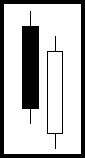 |
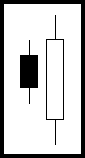
Piercing line. This is a bullish pattern and the opposite of a
dark cloud cover. The first line is a
long black line and the second line is a
long white line. The second line opens lower than the
first line's low, but it closes more than halfway above the first line's real
body. |
 |
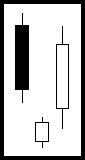
Bullish engulfing lines. This pattern is strongly bullish if it
occurs after a significant downtrend (i.e., it acts as a reversal pattern). It
occurs when a small bearish (filled-in) line is engulfed by a large bullish (empty)
line. |
 |
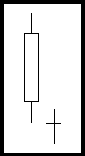
Morning star. This is a bullish pattern signifying a potential
bottom. The "star" indicates a possible reversal and the
bullish (empty) line confirms this. The star can be empty or filled-in. |
 |
Bullish doji star. A "star" indicates a
reversal and a doji indicates indecision. Thus, this pattern usually indicates a
reversal following an indecisive period. You should wait for a confirmation
(e.g., as in the morning star, above) before trading a doji star. The first line
can be empty or filled in. |
| Bearish Patterns |
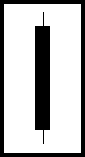 |
Long black (filled-in) line. This is a bearish line. It
occurs when prices open near the high and close significantly lower near the
period's low. |
 |
Hanging Man. These lines are bearish if they occur after a
significant uptrend. If this pattern occurs after a significant downtrend, it is
called a Hammer. They are identified by small real bodies
(i.e., a small range between the open and closing prices) and a long lower shadow
(i.e., the low was significantly lower than the open, high, and close). The bodies
can be empty or filled-in. |
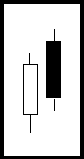 |
Dark cloud cover. This is a bearish pattern. The pattern
is more significant if the second line's body is below the center of the previous
line's body (as illustrated). |
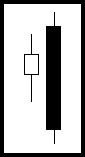 |
Bearish engulfing lines. This pattern is strongly bearish
if it occurs after a significant up-trend (i.e., it acts as a reversal pattern).
It occurs when a small bullish (empty) line is engulfed by a large bearish
(filled-in) line. |
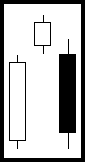 |
Evening star. This is a bearish pattern signifying a
potential top. The "star" indicates a possible reversal and
the bearish (filled-in) line confirms this. The star can be empty or
filled-in. |
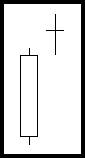 |
Doji star. A star indicates a reversal and a doji
indicates indecision. Thus, this pattern usually indicates a reversal following an
indecisive period. You should wait for a confirmation (e.g., as in the evening
star illustration) before trading a doji star. |
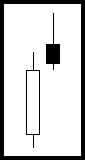 |
Shooting star. This pattern suggests a minor reversal when
it appears after a rally. The star's body must appear near the low price and the
line should have a long upper shadow. |
| Reversal Patterns |
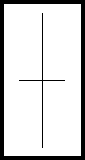 |
Long-legged doji. This line often signifies a turning
point. It occurs when the open and close are the same, and the range between the
high and low is relatively large. |
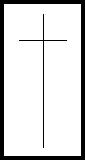 |
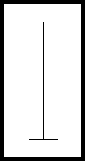
Dragon-fly doji. This line also signifies a turning
point. It occurs when the open and close are the same, and the low is
significantly lower than the open, high, and closing prices. |
 |
Gravestone doji. This line also signifies a turning
point. It occurs when the open, close, and low are the same, and the high is
significantly higher than the open, low, and closing prices. |
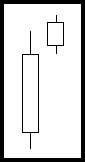 |
Star. Stars indicate reversals. A star is a line with a
small real body that occurs after a line with a much larger real body, where the
real bodies do not overlap. The shadows may overlap. |
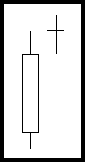 |
Doji star. A star indicates a reversal and a doji
indicates indecision. Thus, this pattern usually indicates a reversal following an
indecisive period. You should wait for a confirmation (e.g., as in the evening
star illustration) before trading a doji star. |
| Neutral Patterns |
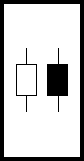 |
Spinning tops. These are neutral lines. They occur when
the distance between the high and low, and the distance between the open and close,
are relatively small. |
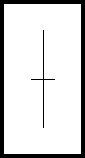 |
Doji. This line implies indecision. The security opened
and closed at the same price. These lines can appear in several different
patterns.
Double doji lines (two adjacent doji lines) imply that a forceful move will follow a
breakout from the current indecision. |
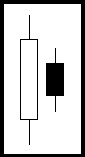 |
Harami ("pregnant" in English). This pattern indicates a
decrease in momentum. It occurs when a line with a small body falls within the
area of a larger body.
In this example, a bullish (empty) line with a long body is followed by a weak
bearish (filled-in) line. This implies a decrease in the bullish momentum. |
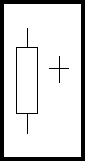 |
Harami cross. This pattern also indicates a decrease in
momentum. The pattern is similar to a harami, except the second line is a doji
(signifying indecision). |
Example
The following chart of Corn illustrates several Japanese candlestick patterns and
principles.
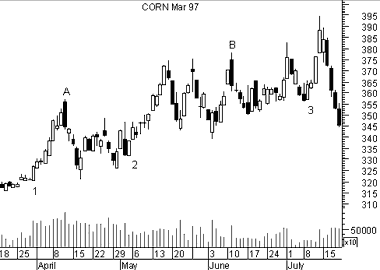
You can see that advancing prices are usually accompanied with empty lines (prices
opened low and closed higher) and that declines are accompanied with filled-in lines
(prices opened high and closed lower).
Bearish engulfing lines occurred at points "A" and "B" (and prices subsequently moved
lower). Bullish white lines occurred at points "1," "2," and "3" (as prices moved
higher).
|